
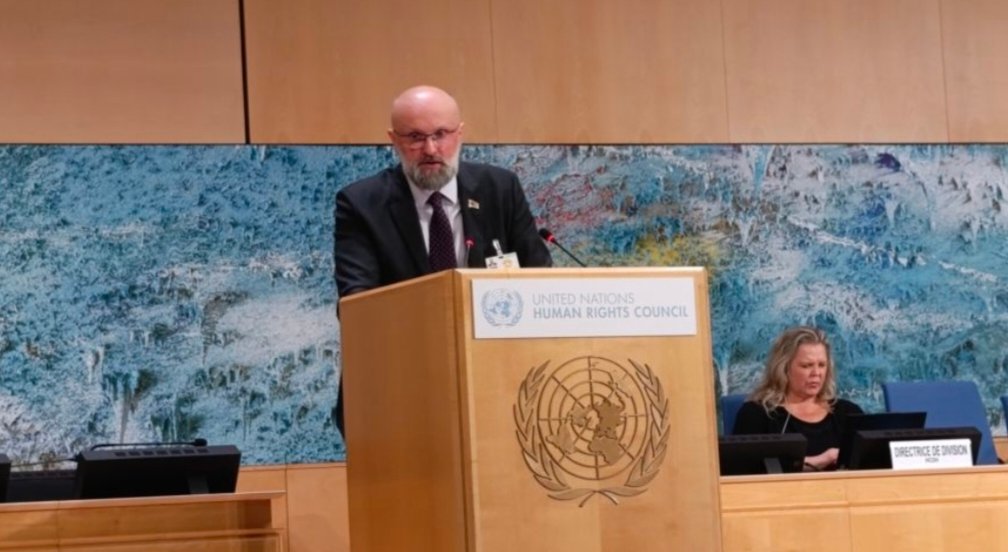
Deputy Foreign Minister Igor Sekreta criticizes selectivity, sanctions agenda at 61st UNHRC session in Geneva
GENEVA — Belarus has sharply criticized the work of the United Nations Human Rights Council, with Deputy Foreign Minister Igor Sekreta saying the body is increasingly “failing” and risks turning into a “farce.”Speaking during the high-level segment of the Council’s 61st session in Geneva, Sekreta said 2026 marks two key anniversaries for the global human rights framework: the 60th anniversary of the International Covenants on Civil and Political Rights and on Economic, Social and Cultural Rights, and the 20th anniversary of the Human Rights Council itself, which replaced the former Commission on Human Rights.He recalled that Belarus had opposed the replacement of the Commission at the time, arguing reforms rather than restructuring were needed. “It is always easier to break than to build,” he said, adding that despite numerous mechanisms and procedures in place, the Council has failed to produce meaningful results.
According to the Belarusian diplomat, dissatisfaction with the Council is growing among many states. He alleged that the body is being used by certain countries to advance political agendas, impose unilateral sanctions and pressure governments under the banner of promoting democracy.Sekreta also criticized what he described as “selective scrutiny,” questioning why some countries face intense examination while others avoid similar attention. He pointed to issues such as the status of stateless persons in Latvia, the treatment of migrants at EU borders, and restrictions on alternative media in certain European states, claiming these matters have not received adequate consideration.Another major concern raised by the Belarusian official was the use of unilateral coercive measures, or sanctions. He argued that such measures harm ordinary citizens and undermine human rights. As an example, he contrasted rising energy costs in parts of Europe during the winter with Belarus’ decision to delay increases in utility tariffs despite what he described as unprecedented sanctions pressure.
Sekreta said the broader crisis facing the United Nations is rooted not in funding shortages but in what he called a divisive human rights agenda. He urged member states to reconsider spending on mechanisms that, in his view, do not deliver tangible outcomes.He warned that institutional reforms and budget cuts alone would not resolve the Council’s challenges unless member states return to what he described as fundamental principles: sovereign equality, non-interference in internal affairs, and impartial cooperation.“Human rights must not be used as a tool of political pressure,” he said, stressing that the legitimacy of the Council depends on adherence to these principles.Highlighting domestic priorities, Sekreta described Belarus as a stable state focused on sustainable development, social protection and equal opportunities. He noted that 2026 has been declared the Year of Women in Belarus, aimed at strengthening women’s role in society.
The deputy minister called for dialogue and mutual respect within the international system, saying constructive engagement remains the only path to restoring trust and effectiveness in global human rights institutions.