
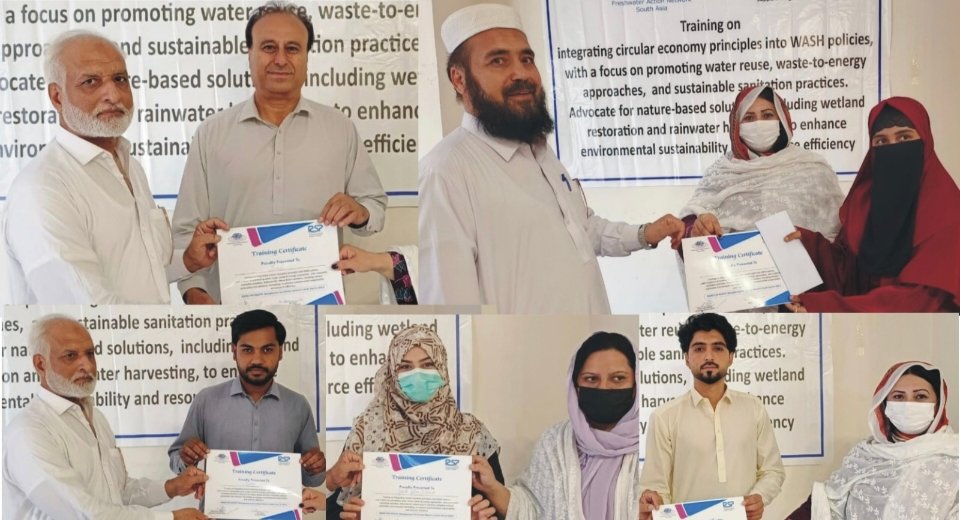
Mardan: A comprehensive training workshop on “Integrating Circular Economy Principles into WASH Policies, Promoting Water Reuse, Waste-to-Energy Solutions, and Sustainable Sanitation and Wastewater Management Practices” was organized at a local hall in Mardan with the support of the Fresh Water Action Network South Asia Pakistan (FWAN South Asia Pakistan) and under the auspices of the Integrated Regional Support Programme (IRSP). The workshop was attended by experts, social activists, youth, students, community representatives, civil society members, and people from various walks of life.Addressing the participants, renowned trainer from Khyber Pakhtunkhwa, Muhammad Yousaf, said that climate change is one of the most serious challenges facing the world today.
He stressed that sustainable management of water resources, restoration of wetlands, rainwater harvesting for multiple uses, prevention of water wastage, and the promotion of environmentally friendly sanitation systems have become essential to mitigating the adverse impacts of climate change.He further stated that integrating circular economy principles into national and provincial WASH (Water, Sanitation and Hygiene) policies would not only help conserve water resources but also significantly reduce environmental pollution. According to him, water reuse, proper wastewater treatment, waste-to-energy technologies, and sustainable drainage systems are critical requirements for the future. These measures would reduce pressure on natural resources, improve sanitation conditions in both urban and rural areas, enhance public health, and contribute to achieving the Sustainable Development Goals (SDGs).Speaking on the occasion, IRSP Executive Director Shah Nasir emphasized that effective policymaking in the water, sanitation, and hygiene sector is the need of the hour. He said that addressing the growing threats of climate change requires strong collaboration among government institutions, civil society organizations, educational institutions, youth, and local communities to ensure sustainable and environmentally responsible development.The workshop was also addressed by Muhammad Ismail, Imran Khattak, Nosheen Sardar, Lubna, and Kiran.
The speakers highlighted the importance of raising public awareness about water conservation, modern sanitation systems, effective waste management, rainwater harvesting, efficient use of water resources, and environmentally sustainable policies. They noted that the concept of a circular economy plays a vital role in the efficient utilization of resources, reduction of waste, and protection of the natural environment, thereby promoting both economic growth and environmental sustainability.During the workshop, participants took part in practical exercises, group discussions, and interactive question-and-answer sessions focusing on sustainable water management, WASH policies, climate change adaptation, eco-friendly sanitation systems, rainwater harvesting, safe wastewater reuse, and innovative waste-to-energy technologies. Experts explained that even small actions taken at both individual and community levels can make a significant contribution to environmental protection and help address the growing water crisis.The workshop witnessed active participation from men and women, students, youth, social workers, community representatives, civil society members, and individuals from diverse professional backgrounds. At the conclusion of the event, participants reaffirmed their commitment to promoting awareness about water conservation, sanitation and hygiene, environmentally friendly lifestyles, and climate change adaptation within their respective communities to help ensure a cleaner, safer, and more sustainable environment for future generations.