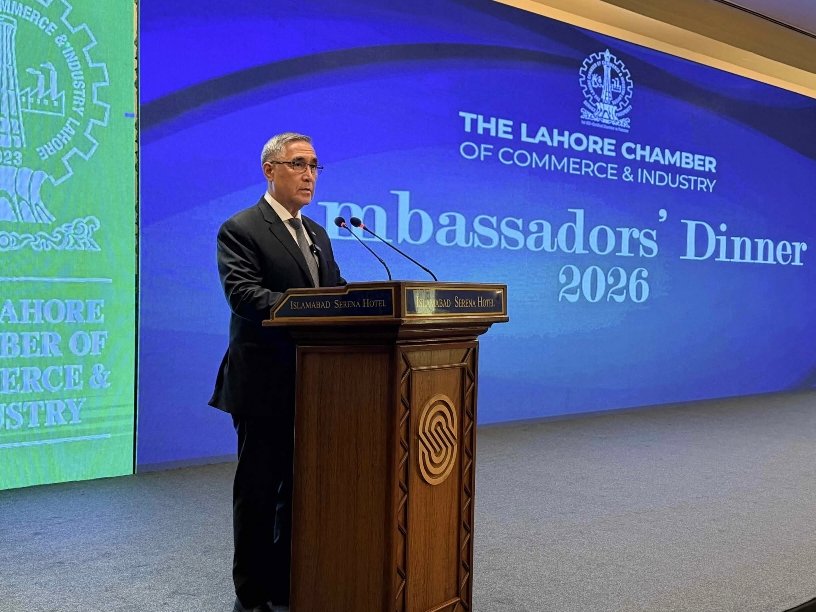

Pakistan’s International Seminar on the Indus Waters Treaty in Islamabad exposed a troubling reality: India’s decision to keep the treaty “in abeyance” is being seen in Pakistan not as a routine policy disagreement, but as an unlawful attempt to convert water into a political weapon. The speakers at the seminar argued that the Indus Waters Treaty remains a binding international agreement and that unilateral suspension has no recognized basis in international water law or treaty practice. They warned that when a state begins treating shared rivers as leverage, it is not defending security; it is undermining the legal order that keeps conflict from escalating. Deputy Prime Minister and Foreign Minister Ishaq Dar said the treaty is still valid, binding, and operative, and cautioned that any attempt to interfere with Pakistan’s allocated waters would threaten regional peace and security. His remarks reflected a broader concern in Pakistan: the Indus Basin is not merely a water source, but the backbone of agriculture, livelihoods, hydropower, and food security for millions of people.
From Pakistan’s perspective, India’s posture is not a technical disagreement over river management, but a direct challenge to downstream survival. Former law minister Ahmer Bilal Soofi made the legal point more sharply. He argued that “abeyance” is not a recognized legal status under the Vienna Convention on the Law of Treaties or international water law. A treaty can be suspended or terminated through lawful procedures, but not through an invented political formula that tries to avoid responsibility while preserving pressure. That distinction matters, because if India’s approach is accepted, any state could weaken its treaty obligations whenever it finds compliance inconvenient. The seminar also brought out a deeper strategic concern: water insecurity is being turned into a tool of coercion. Former foreign minister Hina Rabbani Khar described India’s conduct as part of a shift from rule-making to rule-breaking, warning that the move damages not just bilateral relations but the wider credibility of treaty-based cooperation. Former foreign minister Bilawal Bhutto Zardari said the Indus Basin is Pakistan’s lifeline and that restricting water flow should be treated as a national security threat, not as an ordinary diplomatic issue. Those arguments reflect a growing consensus in Pakistan that water can no longer be separated from sovereignty and civilian security. Former federal minister Khurram Dastagir Khan added that India’s actions amount to “weaponizing water,” especially when combined with reduced data sharing and operational moves on upstream infrastructure. He argued that such behavior creates uncertainty downstream, disrupts planting decisions, and can intensify both floods and droughts. The burden of that uncertainty falls on farmers, rural communities, and an economy already vulnerable to climate stress. In other words, the harm is not theoretical; it reaches the fields, canals, and households that depend on predictable river flows.
Mehr Ali Shah stressed that Pakistan has continued to honor its own obligations by sharing data, maintaining correspondence, and seeking consultations, while India has allowed the treaty’s institutional mechanisms to wither. That point is important because the Indus Waters Treaty was designed to survive political hostility by keeping channels of communication open. When those channels are ignored, the treaty becomes weaker not because it was flawed, but because one party has chosen non-engagement over cooperation. International voices at the seminar reinforced the same message. Laurie A. Watkins described the treaty as one of the rare successes of diplomacy between rivals and emphasized that transparency, legal institutions, and equitable river governance are essential to preventing crisis. Dr. Victor Gao warned that threats to cut water to downstream populations can raise serious humanitarian and legal concerns, and he called for broader multilateral thinking on transboundary water management. Their interventions showed that Pakistan’s concerns are not isolated or emotional; they sit within a wider global understanding that shared rivers must be governed through law, not pressure. The central issue, then, is not only whether India can legally justify its move. It is whether the international community will allow a major upstream state to recast a treaty as optional whenever it suits political needs. If that standard is accepted, the consequences will go far beyond South Asia.
Every downstream country would be forced to wonder whether its water rights could be overridden by strategic calculation. Pakistan’s warning is therefore larger than the bilateral dispute itself: once water is weaponized, the risk is not only scarcity, but instability. For India, the message from the Islamabad seminar was clear. The Indus Waters Treaty must be defended as a legal obligation, not treated as a temporary convenience. India’s “abeyance” claim has been widely criticized because it lacks firm legal standing and because it turns a peace mechanism into a pressure tactic. That is why the issue has become so sensitive: it is not just about rivers, but about whether power will be allowed to override law.