
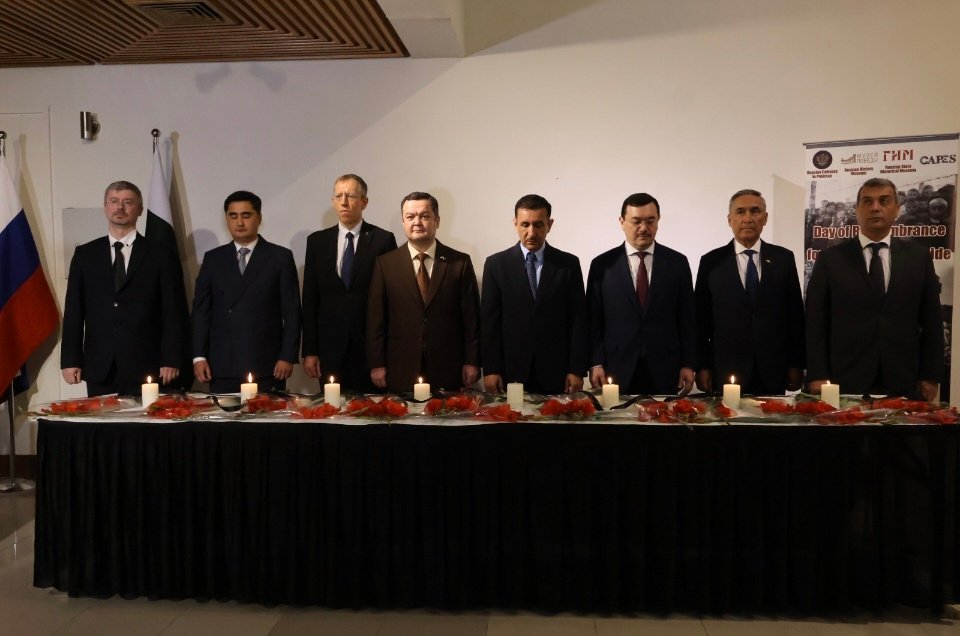
Islamabad witnessed a solemn commemoration on April 17 as the Embassy of Russia in Pakistan inaugurated a photo exhibition marking the Day of Remembrance of the Victims of the Genocide of the Soviet People during the Great Patriotic War (1941–1945).The ceremony brought together ambassadors from CIS countries including Azerbaijan, Belarus, Kyrgyzstan, Tajikistan, Turkmenistan, and Uzbekistan, along with envoys from friendly nations such as Cuba, Iran, Kenya, Rwanda, Syria, and Zimbabwe. Representatives from Pakistan’s Ministry of Foreign Affairs, as well as diplomats from Kazakhstan, Egypt, and other countries, also attended.
Members of the Russian diaspora and Pakistan’s academic community were present at the event.Addressing the gathering, Russian Ambassador Albert P. Khorev highlighted that Nazi Germany’s invasion of the Soviet Union in 1941 triggered the deadliest conflict in history, driven by ambitions to seize territory, exploit resources, and уничтожe a significant portion of the population. He underscored the immense civilian toll, noting that of the 27 million lives lost, approximately 14 million were victims of systematic extermination, including mass executions and deaths in concentration camps.
The ambassador also shared a personal account of his great-grandmother’s deportation to Germany for forced labor, reflecting the widespread suffering endured by millions of Soviet families.He further noted that the designation of April 19 as the remembrance day by Vladimir Putin is partly grounded in the findings of the Nuremberg Trials verdict of October 1, 1946, which recognized the systematic nature of Nazi atrocities.In his concluding remarks, Ambassador Khorev emphasized the importance of preserving historical truth and preventing distortion of World War II events, while reaffirming Russia’s commitment to countering neo-Nazism.
Dr. Gul-i-Ayesha Bhatti, Director of CAPES Eurasian Chapter, also addressed the audience, highlighting that the extraordinary sacrifices and heroism of the Soviet people during World War II paved the way for Europe’s freedom and independence.The ceremony concluded with participants lighting candles and observing a minute of silence in memory of the victims.The exhibition, featuring archival material documenting the genocide of the Soviet people, will remain open to visitors at the Pakistan National Council of the Arts until April 19.