
History rarely unfolds as a simple chain of events rather, it is shaped in defining moments when nations are compelled to confront existential questions of identity, sovereignty, and destiny. These moments transcend the ordinary—they become epochs of struggle where ideas, conviction, and power converge. Pakistan’s history is marked by such decisive phases: from the ideological struggle that led to its creation, to the unresolved Kashmir dispute, from the tragedy of Dhaka to the protracted war against terrorism, and now to the complex realities of hybrid warfare. Seen collectively, these are not isolated episodes but interconnected chapters of a single, enduring contest—a maarka-e-haq, a battle for truth.
Colonel (Retd.) Ashfaq Hussain’s Maarka-e-Haq enters this discourse not merely as a chronicle of events, but as a structured attempt to interpret this continuum. It is a work that seeks to connect the past with the present and, in doing so, offers a framework to understand the future. The symbolism begins even before the first page is turned. The book’s cover—featuring a resolute clenched fist against Pakistan’s green crescent—projects a powerful visual metaphor of unity, resilience, and defiance. It signals that this is not just a narrative of conflict, but one of resolve.The thematic foundation of the book is laid on its opening page with a verse from Surah As-Saff (61:4): “Indeed, Allah loves those who fight in His cause in ranks as though they are a solid structure.” This Qur’anic imagery of bunyān al-marsūs—a solid, unbreakable wall—serves as the central organizing principle of the book. It encapsulates the idea that strength lies not merely in individual capacity but in disciplined unity. In an age where fragmentation often defines both domestic and global politics, this message resonates with particular urgency.
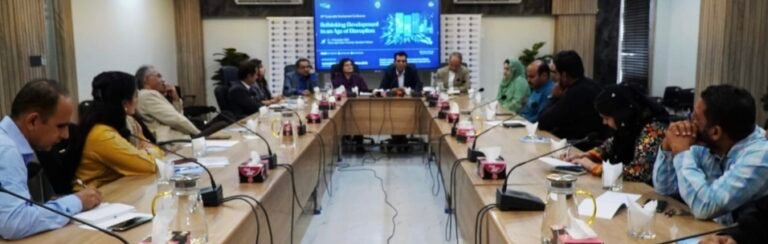
The recent launch of Maarka-e-Haq brought together voices from military, academic, and journalistic circles, transforming what could have been a routine literary event into a meaningful intellectual exchange. Among the speakers, Dr. Yousaf Alamgirian, Editor of Hilal, offered a compelling analysis of contemporary warfare. His central argument—that modern conflict extends far beyond conventional battlefields into the domains of perception, information, and narrative—captures the essence of the strategic shift defining the 21st century.This observation is critical. In an era shaped by digital media, cyber influence, and psychological operations, the ability to control narratives has become as consequential as the ability to deploy force. Dr. Alamgirian emphasized that without a coherent and credible national narrative, even the most significant military victories risk losing their strategic value. Maarka-e-Haq, in this sense, emerges as an effort to consolidate that narrative—to provide clarity in a space often clouded by distortion and competing interpretations.Mujtaba Haider Imran’s remarks added another dimension to this discussion. He highlighted the book’s reliance on evidence-based analysis, a feature that distinguishes it in a landscape often dominated by emotive rhetoric.
By grounding its arguments in historical continuity and verifiable facts, the book not only strengthens its intellectual credibility but also positions itself as a reference text for serious readers. His personal reflection on encountering the author’s earlier work underscores the lasting impact of Colonel Ashfaq’s writing—a blend of accessibility and analytical depth that continues to engage diverse audiences.While the book is situated within the context of recent regional tensions—particularly India’s aggressive posturing and Pakistan’s calibrated response under the framework of Bunyān al-Marsūs—its scope is far broader. It moves beyond immediate events to explore the structural dynamics that have long defined South Asia’s geopolitical landscape.At the core of this exploration lies the Kashmir dispute. Hussain traces its historical evolution with precision, beginning with the political awakening of the 1930s, reflected in the 1934 elections and the establishment of the Praja Sabha. He follows this trajectory through the critical junctures of 1947, including the June 3 Partition Plan and the July 19 resolution advocating accession to Pakistan. This continuity is essential in understanding Kashmir not as a transient political issue, but as a question rooted in the will of its people. The persistent denial of this will, alongside India’s departure from United Nations resolutions, is presented as a central factor in the region’s enduring instability.The book also brings into focus the strategic dimension of water—a subject often underestimated in public discourse. By revisiting the origins of the Indus Waters dispute and examining subsequent developments, Maarka-e-Haq highlights how water has evolved into a tool of geopolitical leverage. In a country where agriculture remains the backbone of the economy, the control and flow of river systems originating in Kashmir are not merely technical concerns but matters of national survival.
Equally significant is the book’s examination of India’s internal contradictions. By shedding light on separatist movements, governance challenges, and the widening gap between projected global image and domestic realities, it presents a nuanced critique of India’s position. This analysis is further strengthened by its exploration of media warfare, where misinformation, propaganda, and psychological manipulation are used to construct narratives that often diverge sharply from ground realities.On the military front, Maarka-e-Haq offers a detailed account of operational synergy across Pakistan’s armed forces. It highlights how coordination between the army, navy, and air force has evolved into a defining strength, enabling effective responses to complex challenges. From ground operations to maritime vigilance and aerial superiority, the concept of bunyān al-marsūs finds concrete expression in institutional cohesion and professional excellence.However, the book does not reduce national strength to military capability alone. It underscores the equally critical role of diplomacy in shaping outcomes. In today’s interconnected world, where international opinion can influence strategic realities, diplomatic engagement becomes a vital extension of national policy. Pakistan’s efforts to articulate its position on global platforms and counter adversarial narratives are presented as integral to its overall strategy.The interplay between political leadership and national security also finds due recognition. The decision by former Prime Minister Nawaz Sharif to declare Pakistan a nuclear power in 1998 is rightly identified as a turning point that redefined the region’s strategic balance. This was not merely a technological milestone but a statement of sovereign will. Subsequent initiatives aimed at economic development and regional connectivity, particularly through large-scale infrastructure projects, have sought to build on this foundation.In recent years, the alignment of political, diplomatic, and military leadership has contributed to a renewed sense of direction.
Under the stewardship of contemporary leadership, this alignment has translated into both operational effectiveness and strategic clarity—reinforcing Pakistan’s position in an increasingly complex global environment.Brigadier Saulat Raza’s characterization of Bunyān al-Marsūs as the embodiment of national unity captures the spirit that runs through the book. It is a vision of a nation standing as a cohesive whole, where institutional strength and public resolve converge. Such unity, the book suggests, is not incidental; it is cultivated through shared purpose, disciplined organization, and a clear sense of direction.Ultimately, Maarka-e-Haq is more than a narrative of past and present conflicts. It is an invitation to think critically about the future. It challenges readers to move beyond passive consumption of information and engage with the deeper forces shaping national and regional dynamics.
Its central message is both timely and enduring: that the battles defining our era are fought not only on physical frontiers but within the realms of thought, perception, and belief.As Pakistan navigates the complexities of the 21st century, the need for such intellectual clarity becomes ever more pressing. The responsibility lies not only with institutions but with society at large—to understand, to question, and to contribute to a coherent national narrative. For in the final analysis, the true maarka-e-haq is not confined to geography; it is waged in the minds of people, and its outcome determines the course of nations.