
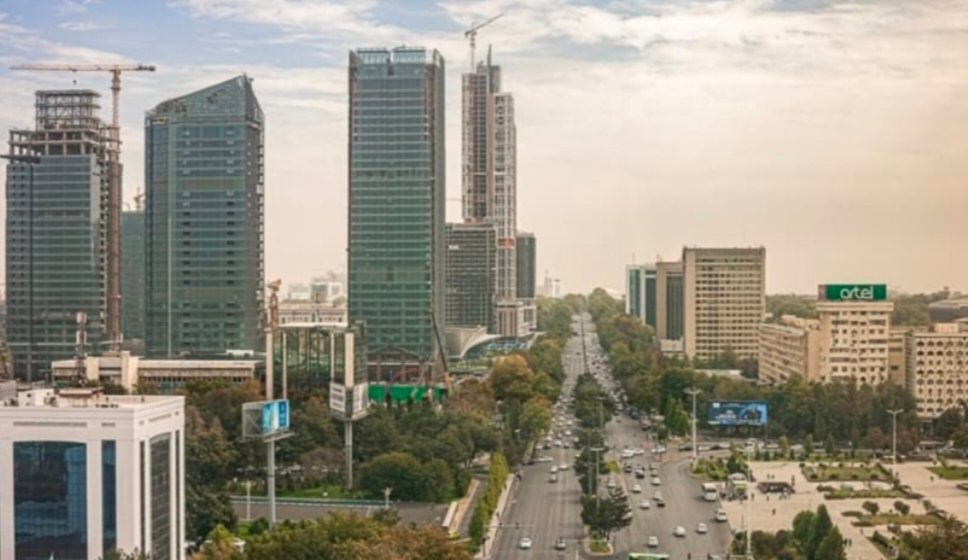
ISLAMABAD, May 16 (IN): Uzbekistan posted one of the world’s fastest-growing economies in the first quarter of 2026, with gross domestic product expanding by 8.7% amid record investment inflows, rising exports, easing inflation and broad market reforms, government-linked analysts said.The strong performance exceeded forecasts from major international financial institutions, underscoring the accelerating pace of economic transformation in the Central Asian nation.
According to data cited by Khurshed Asadov of the Center for Economic Research and Reforms, GDP at current prices reached $36.9 billion during the January-March period.Earlier forecasts from the Asian Development Bank projected growth at 6.7%, while the World Bank revised its estimate upward from 6% to 6.4% in April.The International Monetary Fund also raised its outlook from 6.2% to 6.8%, though actual growth significantly surpassed those expectations and,said a release issued here.
Construction emerged as the fastest-growing sector, expanding 15%, while services ,the country’s largest economic segment ,grew 8.8%.Industrial production rose 8%, and agriculture increased 5.1%.Manufacturing industries recorded particularly sharp gains.Oil refining surged 29.5%, apparel and textile production increased 15.3%, and knitwear output jumped 26.9%. Automotive manufacturing expanded 12.5%, including bus production, which climbed 64.7%, and truck production, up 46.6%, article said.Education and financial services led growth within the services sector, each rising more than 22%.According to data, Uzbekistan’s economic reforms gained additional international recognition this year after the country climbed 14 places in the Index of Economic Freedom, entering the category of “moderately free” economies for the first time.Despite global inflationary pressures, authorities also managed to significantly slow price growth.
Global oil prices have risen nearly 40% since the start of the year, while geopolitical tensions disrupted logistics corridors and pushed transportation costs for trade routes up by as much as 30%. Imports of cattle reportedly fell by half during the quarter, increasing pressure on domestic food supplies.To stabilize food prices, the government introduced subsidies covering part of the air freight costs for livestock and meat imports. Authorities also approved the import of 100,000 breeding sheep and goats from Mongolia with 50% transport cost compensation.According to article, as a result, inflation eased considerably. Consumer prices rose 1.93% during the first quarter, while annual inflation declined to 7.1% in March, down from 10.34% a year earlier. Monthly inflation in March stood at 0.6%.The government has set a target of keeping annual inflation below 6.5% in 2026.Strong economic activity also boosted public finances. State budget revenues rose 35% year-over-year in the first quarter, with tax revenues increasing 24% and customs revenues up 20%.Local budgets retained significantly more resources as part of the government’s decentralization strategy. District-level budgets totaled $115.3 million, more than four times higher than the same period last year.
According to data issued, the investment activity reached record levels during the quarter, with total capital investment and development projects amounting to $12.85 billion, up 41.5% from a year earlier.Foreign direct investment increased 45.7% to $8.84 billion.Officials said 1,508 new investment projects worth $1.185 billion were launched during the quarter, creating approximately 28,000 jobs nationwide.China remained the largest foreign investor with $6.4 billion invested, followed by Russia, Türkiye, the United Arab Emirates and Germany, according to article.President officials also announced plans to list 30% of state assets worth $2.4 billion on international stock exchanges for the first time. The move is tied to the creation of a National Investment Fund and the transfer of management of 13 strategic enterprises to Franklin Templeton.Exports continued to expand strongly, rising 26% year-over-year to $5.8 billion.Natural uranium exports nearly doubled to $402.6 million, while exports of non-ferrous metals also doubled to $248.7 million.According to date issued, Uzbekistan also broadened its export markets, shipping more than 140 previously unexpected product categories to 86 countries, including the United States, Austria, Poland, South Korea, Iran, Kazakhstan and Afghanistan.
Authorities acknowledged continuing challenges in foreign markets, noting that 908 exporters with signed contracts worth $3.6 billion had not yet been able to begin shipments due to changing external conditions.The government also continued large-scale support programs for small businesses and social welfare.Entrepreneurs received $2.9 billion in financing during the quarter, including $659 million through state-backed programs. More than 21,000 micro projects were launched, helping improve incomes for 52,000 people.Meanwhile, anti-poverty and employment programs contributed to the creation of 167,000 permanent jobs. Poverty declined to 5%, while unemployment fell to 4.7%, with officials projecting further improvement by midyear.
Globally, Uzbekistan’s growth compares favorably with broader economic trends. In April, the IMF lowered its global growth forecast from 3.3% to 3.1%, while growth in advanced economies is expected to remain below 2%.Officials expect Uzbekistan to maintain strong momentum throughout 2026, with projected GDP growth between 8.3% and 8.7%.At the same time, the country’s leadership warned against complacency, citing global uncertainty, intensifying geopolitical competition and the need to sustain reforms, control inflation, attract investment and expand exports in an increasingly unstable international environment.