
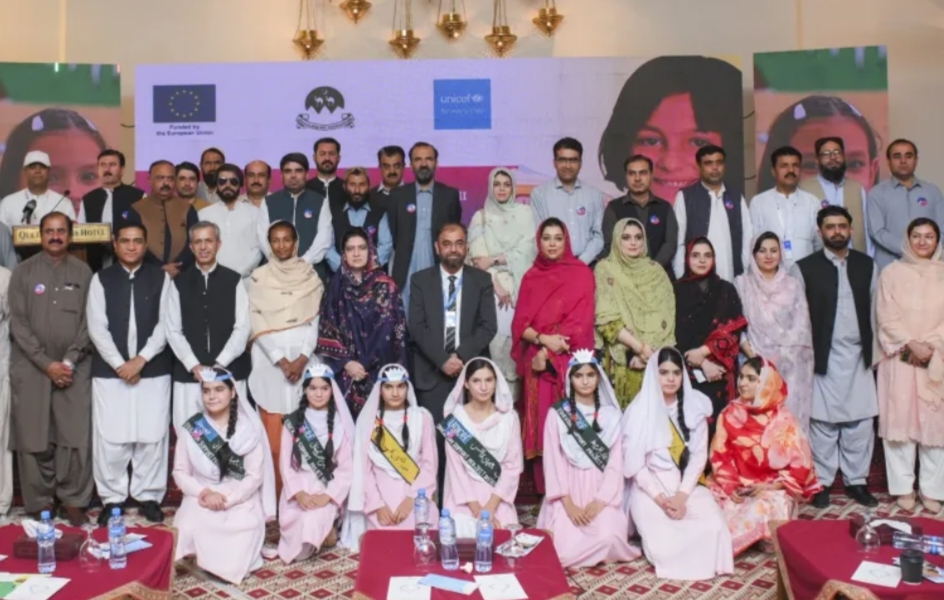
Islamabad, 23 June 2026 – More than 760,000 children in Balochistan gained access to improved learning opportunities under the Balochistan Education Support Programme II (BES-II), a five-year initiative supported by the European Union in partnership with the Government of Balochistan’s School Education Department and UNICEF. The programme officially concluded today at a high-level ceremony in Quetta.Building on the earlier Balochistan Basic Education Programme (2016–2021), BES-II represented the next stage of education reform in the province. With €17.4 million in EU funding from 2021 to 2026, the initiative focused on expanding access to education while strengthening systems that are more inclusive, resilient, and driven by data.
Nearly 335,000 girls benefited from improved schooling opportunities, highlighting the programme’s strong emphasis on gender equity in education.Chief Minister of Balochistan, Mir Sarfaraz Ahmed Bugti, praised the long-standing partnership, saying that a decade of collaboration with the European Union and UNICEF has helped strengthen education systems and improve the lives of children across the province. He expressed appreciation for their continued support and reiterated the commitment to ensuring that every child has access to quality education.The programme introduced several key reforms aimed at improving governance and decision-making in the education sector. These included the province’s first digital school census, real-time monitoring of schools, and the launch of a Virtual Academy that trained more than 10,600 teachers. In addition, over 4,000 teachers received professional development, while 3,000 Parent-Teacher School Management Committees were activated, engaging more than 16,000 community members in school improvement efforts.These system-wide interventions translated into concrete progress on the ground.
More than 20,000 out-of-school children at the primary level and over 2,200 at the middle level were brought back into classrooms through accelerated learning programmes, many of them girls. Improvements in around 1,230 schools created better learning environments for over 150,000 students, while more than 6,100 adolescents were equipped with skills to support future education and employment.“For the European Union, investing in education and skills means investing in the future of Balochistan,” said Dr. Sébastien Lorion, Acting Head of Cooperation at the EU Delegation to Pakistan. “This partnership has helped expand access to basic education and strengthen the foundations of the system. We are proud of what has been achieved and remain committed to supporting better opportunities for every child.”The programme also helped ensure learning continuity during emergencies. More than 6,600 children affected by floods were supported to stay in school, while health, hygiene, and screening services reached over 72,000 adolescent girls and 26,000 children, supporting both well-being and learning outcomes.
UNICEF Representative in Pakistan, Pernille Ironside, noted that the partnership enabled hundreds of thousands of children to regain access to education and skills development, helping them build pathways toward future livelihoods. She said the results demonstrate what can be achieved when government leadership is combined with sustained investment in children and strong technical support.As BES-II comes to an end, it leaves behind strengthened systems, improved governance, and stronger community engagement in education—laying a foundation for continued progress toward ensuring that every child in Balochistan can access quality learning opportunities.