
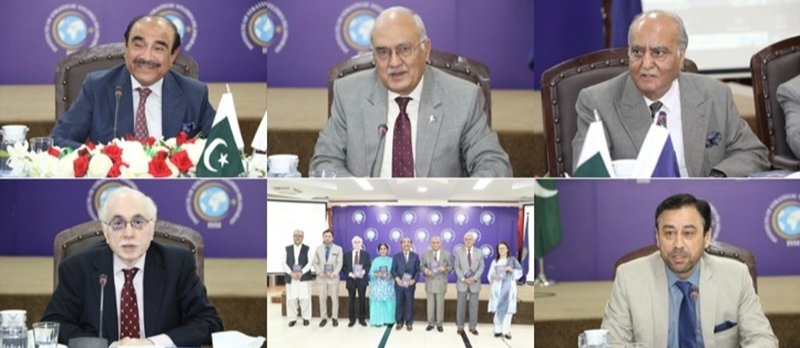
The Institute of Strategic Studies Islamabad (ISSI) hosted the launch of The Third Dimension Policy Prism, authored by Ambassador G. R. Baluch. The book’s discussants included General Khalid Naeem Lodhi, Former Defense Secretary, Pakistan; Ambassador Masood Khalid, Former Diplomat; Dr. Munawar Hussain, Associate Professor, QAU; Dr. Shazia Khalid Cheema, Associate Professor, QAU; and Farukh Pitafi, columnist and anchor.
The event was attended by a wide range of diplomats, acdemics, scholars and media persons.In her introductory remarks, Dr. Neelum Nigar, Director, Centre for Strategic Perspectives (CSP) at ISSI, expressed sincere gratitude to Ambassador G. R. Baluch for choosing ISSI as the platform for the launch of his important work. She appreciated his confidence in the institution and acknowledged his valuable contribution to the discourse on strategic and policy affairs.In his welcome remarks, Ambassador Khalid Mahmood described the book as a timely and significant scholarly contribution at a moment of profound transformation in international politics.
He observed that the contemporary global environment is increasingly shaped by geopolitical competition, technological disruption, economic realignments, and evolving security paradigms, making serious scholarship rooted in diplomatic experience more important than ever. Ambassador Mahmood noted that Ambassador G. R. Baluch’s work successfully combines academic reflection with practical diplomatic insight, presenting foreign policy through a multidimensional lens influenced not only by politics but also by economics, technology, climate change, information flows, and the growing role of non-state actors.
Ambassador G. R. Baluch, while introducing his book, observed that the contemporary world is witnessing a “battle of narratives,” where influence and dominance are increasingly shaped through ideas, discourse, and the ability to give voice to perspectives. Describing the book as “more of a conversation than a conventional text,” he remarked that ideas quietly travel from pages to minds and eventually shape policies and global debates, while also thanking the Institute of Strategic Studies Islamabad for hosting the launch and encouraging meaningful discourse on foreign policy and international affairs.
The reviewers collectively described the book as a timely and multidimensional contribution to contemporary strategic thought. Speaking at the event, General Khalid Naeem Lodhi highlighted the central concept of the “third dimension” in international relations, noting that while traditional strategic thinking has primarily focused on national interests, Ambassador Baluch’s work incorporates ethics and humanity into the foreign policy framework. He noted that through its five chapters, the book examines multiple geographical regions, Pakistan’s relations with different countries, divisions within the Muslim Ummah, developments in the Middle East, and the crisis in Gaza, while also framing contemporary challenges through the “three Cs” — conflict, cooperation, and consensus — and emphasizing the growing influence of technology on diplomacy, economics, and strategic competition. Ambassador Masood Khalid described the book as a valuable and accessible collection of essays addressing key issues in Pakistan’s foreign policy discourse. He noted that it revisits longstanding geopolitical challenges while also engaging with contemporary global and national concerns.
He highlighted its analysis of South Asia, including India’s posture during Operation Sindoor and its strategic implications, as well as the Gaza conflict’s humanitarian and geopolitical dimensions. He added that the book effectively links global developments with Pakistan’s national interests, offering a comprehensive view of contemporary strategic realities.Dr. Munawar Hussain, observed that the author examines international politics not only through the lens of power politics and economic competition but also through ethical, subjective, and value-based dimensions that shape international society. He emphasized that values cannot be separated from global politics.
He further noted that the book critically engages with questions of narrative-making and theory construction, and remarked that while material realities seek causes, human societies are ultimately driven by purpose, making ideology an enduring source of power in international relations. Dr. Hussain also highlighted the book’s emphasis on multilateralism over unilateralism, observing that contemporary global developments increasingly validate the importance of cooperative international engagement. Dr. Shazia Khalid Cheema, noted that the book moves beyond conventional geopolitical analysis by exploring the symbolic, moral, psychological, and cultural dimensions of politics that influence how societies perceive themselves and others. She remarked that the book highlights how political identities are constructed through stories, media discourse, historical memories, and ideological frameworks, making geopolitics itself a battle over perception and meaning-making. Appreciating the intellectual breadth of the work, Dr. Cheema noted that the author skillfully moves from South Asia and the Middle East to global strategic shifts and Pakistan’s internal educational and institutional challenges while maintaining a reflective and analytical approach throughout.
Mr. Farukh Pitafi observed that the book engages both diplomats and academics, combining policy relevance with conceptual depth and theoretical richness. He noted its clear structure across four thematic chapters—South Asia, the Middle East, great powers, and global politics—while maintaining a fast-paced, intellectually engaging flow that keeps readers immersed. He further highlighted its humanistic dimension, particularly its reflections on education, artificial intelligence, and evolving learning environments. Acknowledging the density of ideas, he remarked that the book is highly stimulating and occasionally demands pauses for reflection, while also noting his relatively early engagement with the work compared to other commentators.The launch concluded with the formal unveiling of the book and the distribution of souvenirs to the esteemed speakers.