
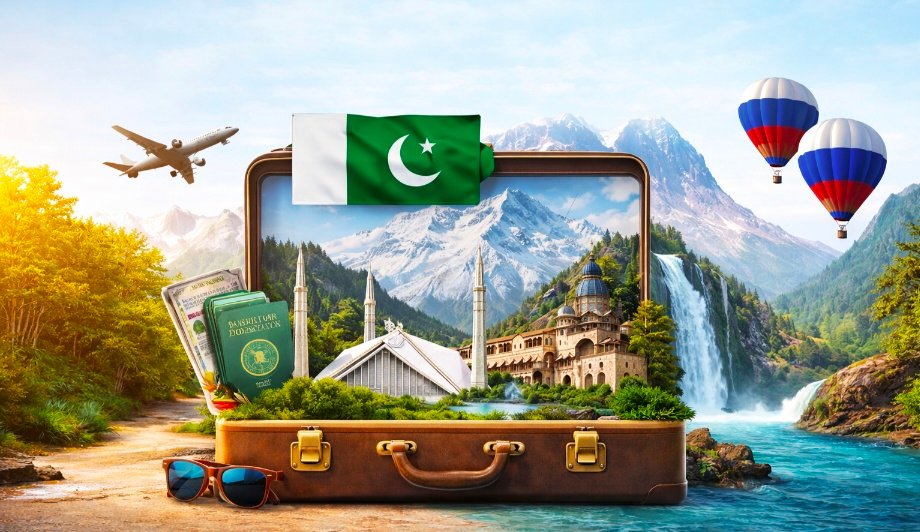
MOSCOW, Apr 05 (IN): Pakistan is aiming to attract up to 50,000 Russian tourists annually and generate as much as $1 billion in revenue, as shifting global travel trends open new opportunities in the Russian outbound tourism market.Pakistan’s Ambassador to Russia, Faisal Niaz Tirmizi, said that changing geopolitical and economic conditions, along with instability in parts of the Middle East, are encouraging Russian travelers to explore alternative destinations.
He noted that Pakistan is increasingly being considered a viable option.In an exclusive interview, Ambassador Tirmizi highlighted that the Russian outbound tourism market, which previously saw around 24 million travelers annually before 2022, has now declined to approximately 15 million. Despite the drop, he emphasized that the market still holds strong potential for countries offering secure, accessible, and cost-effective travel experiences.He said Russian tourists typically prefer warm destinations during winter and spend between $1,000 and $5,000 on trips lasting one to two weeks. Countries catering to this segment generate between $1 billion and $7 billion annually.The ambassador revealed that Pakistan plans to initially attract small tourist groups through tour operators, gradually increasing the number to 50,000 visitors per year. If managed effectively, this segment alone could contribute up to $1 billion annually to the national economy.
Referring to growing bilateral ties, he said Russian President Vladimir Putin views Pakistan as a friendly country and supports enhanced cooperation in tourism, trade, education, and culture.Ambassador Tirmizi noted that Pakistan’s tourism sector has witnessed notable growth in recent years, supported by government initiatives such as the Green Pakistan program. In 2025, the country received over one million international tourists, marking a significant increase compared to previous years.He added that global media outlets, including BBC and CNN, have recognized Gilgit-Baltistan as a leading travel destination, boosting Pakistan’s international profile.To facilitate foreign visitors, Pakistan has simplified visa procedures, allowing citizens from 126 countries to benefit from the “Visa Prior to Arrival” facility. Additionally, the government has launched an online platform, “Tourism on the Palm,” providing travel-related information and services.On infrastructure development, the ambassador said 17 tourism projects have been completed in the past two years under Green Tourism initiatives, while 10 new hotels and resorts are planned for 2026–27 in destinations such as Gadani, Sonmiani, and Hunza.Discussing broader trends, he said global tourism continues to be influenced by security concerns and shifting travel routes. Instability in parts of the Middle East has reduced tourist flows to the region, prompting travelers to consider destinations in Southeast Asia, Central Asia, and parts of Europe.He also pointed out that disruptions in aviation routes, particularly through the Middle East, are affecting global connectivity, while investors are increasingly looking toward stable and emerging tourism markets.
Ambassador Tirmizi identified northern regions, including Hazara Division, Skardu, and Hunza, as key attractions for adventure and cultural tourism. He also emphasized Pakistan’s strategic geographic position as a potential transit hub linking Asia, Europe, and Africa.However, he acknowledged that challenges persist, particularly regarding global perceptions of security, though these are gradually improving. He noted a growing trend of independent foreign travelers visiting Pakistan and sharing positive experiences.He stressed the need for a coordinated national strategy to promote tourism internationally, including improved branding, stronger engagement with airlines, and effective use of digital platforms.
Encouraging low-cost carriers and leveraging media and film industries could further enhance Pakistan’s image.Concluding his remarks, Ambassador Tirmizi said the evolving global tourism landscape presents a timely opportunity for Pakistan to establish itself as a competitive destination, provided it adopts a clear and proactive approach.