
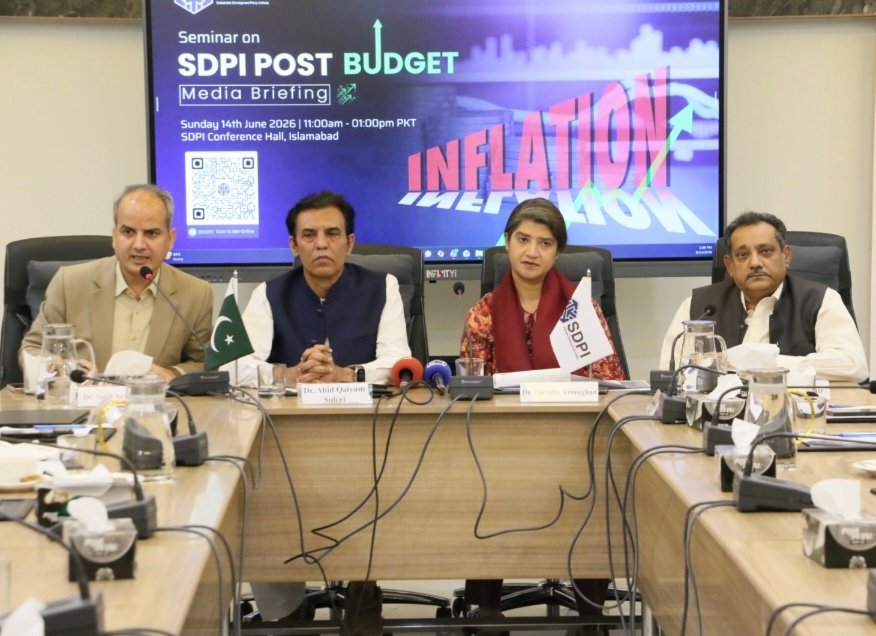
ISLAMABAD (14 June 2026): The Federal Budget 2026-27 is a planning instrument rather than something good or bad, said Dr Abid Qaiyum Suleri, the Executive Director of Sustainable Development Policy Institute (SDPI), while speaking at a post-budget briefing of the Institute here on Sunday.The government has attempted to provide relief to documented sectors of economy while maintaining fiscal discipline, he said, adding that the salaried class, information technology sector and other documented businesses have received notable incentives in the budget.Dr. Suleri, however, pointed out that the budget lacked a clear strategy for bringing the undocumented economy into tax-net and warned of practical challenges in implementing agricultural income taxation. He said relief measures were being offset through revenues generated from petroleum levy and sales taxes. Lauding provincial cooperation in federal fiscal arrangements, he apprehended that reduction in provincial development spending might affect education, health, water and local government sectors. He stressed the need for bringing transparency in the Federal Board of Revenue (FBR)’s automated assessment and audit reforms, alongside robust safeguards for citizens’ data privacy.SDPI Deputy Executive Director (Research) Dr Sajid Amin Javed said the budget remained focused on fiscal stabilization rather than structural transformation and export-led growth. He noted that the government’s 4 per cent GDP growth target appeared achievable, but much of the projected expansion is expected to come from the real estate sector, which generates limited employment and has weak linkages with construction and manufacturing.He argued that the official inflation target of 8.2 per cent is underestimated, projecting inflation to remain between 11 and 13 per cent due to elevated petroleum prices, a record petroleum development levy (PDL) target of Rs1.67 trillion, higher energy costs and external oil market uncertainties. He warned that interest rates could remain within the range of 12-13 per cent and may rise further if global oil prices increase.Dr Javed said the Rs15.264 trillion tax revenue goal was achievable through inflation, economic growth, new taxation and improved compliance, but substantial gains from the retailers’ tax scheme were elusive. He suggested increasing annual income tax exemption threshold for salaried class to Rs1.2 million, providing direct support to the construction sector, reducing the highest income tax slab to 30 per cent, eliminating the filer and non-filer distinction, bringing all forms of income under the FBR’s income tax regime, broadening the role of Tax Policy Office beyond revenue collection objectives and reducing reliance on petroleum levy revenues, which he described as both inflationary and a disincentive to deeper tax reforms.SDPI Deputy Executive Director (Policy) Dr. Shafqat Munir Ahmed said the budget could not be categorized entirely as a stabilization budget, though the economy remained under the influence of IMF programme and fiscal consolidation efforts. He noted that the government had focused on improving tax compliance and revenue administration rather than imposing major new taxes. While welcoming the introduction of a faceless tax system and improvements in tracking and monitoring mechanisms, he stressed the need for transparent implementation and stronger measures for financial inclusion.Dr. Munir also called for strengthening climate resilience in agriculture and better integrate social protection with disaster management systems. He also called for greater investment in early warning systems, anticipatory action and climate-responsive cash transfers through the Benazir Income Support Programme (BISP).SDPI Research Fellow Dr Fareeha Armughan said in Pakistan, poverty has become increasingly complex due to climate risks and multidimensional deprivation. Welcoming the 17 per cent increase in BISP budget and the plan to expand beneficiary families to 10.2 million, she said Pakistan needs to move beyond conventional cash assistance to adaptive social protection models linked with employment generation, micro-enterprises and women’s economic empowerment.Dr. Armughan stressed the need for taking measures to increase female labour force participation and called for targeted support programmes for vulnerable households that fall outside traditional safety nets and emphasized on improved transparency, strong mechanisms and digital payment systems.SDPI Research Fellow Dr Khalid Waleed said the budget continued to prioritize increasing electricity generation capacity rather than improving demand-side management and energy efficiency. He advocated retiring imported fuel-based power plants and accelerating investment in battery storage technologies.Dr. Waleed observed that green subsidies remained limited relative to revenues generated from the energy sector and noted that a large share of energy-related support continued to be consumed by circular debt and independent power producer liabilities. Welcoming the incentives for electric vehicles, he stressed the need for a broader national framework defining and measuring green budgeting in line with international standards.SDPI Research Fellow Dr. Irfan Ahmad Chatha said the primary objective of the budget was macroeconomic stability and fiscal discipline rather than rapid economic growth. He argued that describing it as a growth budget would be unrealistic.He stressed that budget analysis should be conducted within the framework of medium-term fiscal planning rather than annual figures alone. He also called for stronger internal audit systems, greater expenditure transparency and further reforms in public-sector governance and procurement mechanisms.SDPI Research Fellow Zainab Naeem expressed concern over a sharp reduction in climate-tagged allocations despite the Economic Survey’s recognition of climate change as a major economic threat. She said allocations for climate adaptation, water management, agriculture and glacier-related initiatives had declined significantly, while mitigation-related spending had also witnessed a substantial cut. Ms Naeem said the government was generating considerable revenue through climate-related levies and taxes, but only a limited share was being reinvested in climate action. She suggested allocating a portion of climate-support levies to adaptation and renewable energy projects and called for regular monitoring and impact assessment of climate-budget tagging mechanisms.